


Our sustainability strategy aligns our company’s long-term vision with the key impacts, risks and opportunities of our business. The aim is to make sustainability systematically manageable and to integrate it into core decision-making processes.
How we manage sustainability
We begin by analysing the issues that are particularly relevant to our business – taking into account our impact on the environment and society, as well as the resulting risks and opportunities for EEW. On this basis, we set priorities, define targets and measures, and monitor progress using key performance indicators and processes. In this way, we ensure that sustainability at EEW is not merely described, but actively managed.
Sustainability in our Business Model
Our strategy is closely linked to our core business. We process non-recyclable waste and generate energy from it. This places us at the interface between waste management and the circular economy, energy supply and critical infrastructure.
Our task is to ensure reliable waste disposal, use energy efficiently and systematically reduce environmental impacts. In doing so, ecological, economic and operational requirements are sometimes in conflict with one another. We make decisions based on our strategic priorities, taking into account impact, cost-effectiveness and security of supply.
Our Key areas
Our key priorities are directly derived from our sustainability roadmap. They bring together the areas in which we manage our key impacts, risks and opportunities:
- Climate impact and energy contribution
- Resource use and the circular economy
- Stable and secure facilities as the foundation of our impact
- Employees and organisation
- Accountability, governance and market confidence
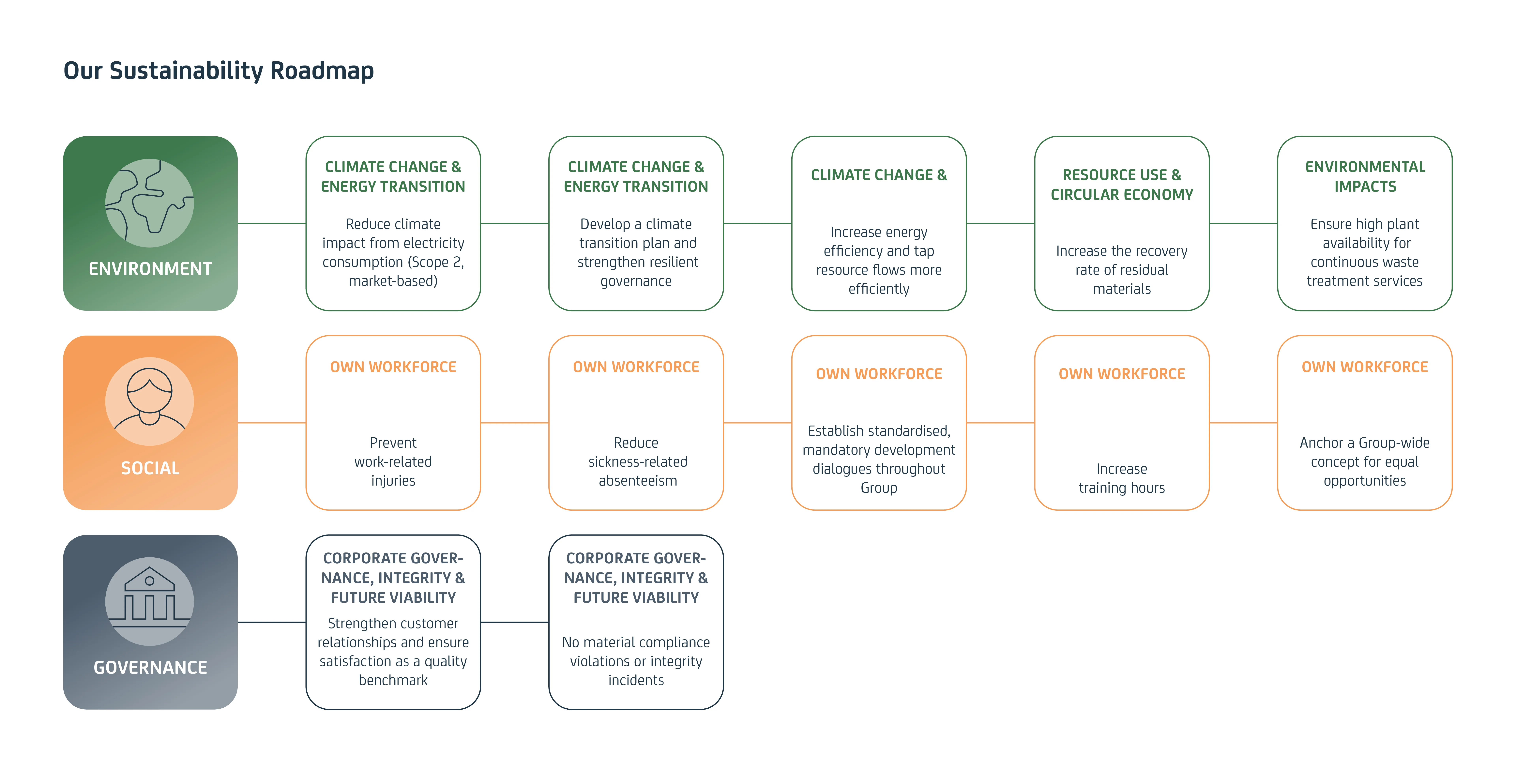
Our Roadmap
Our sustainability roadmap translates strategic priorities into specific targets and actions. It serves to make progress transparent, review priorities on a regular basis and further improve our ability to steer the process.
Our plants are used for the thermal treatment of non-recyclable residual waste and for utilising the energy contained in it.
Our focus is on:
- reducing greenhouse gas emissions
- increasing energy efficiency
- further developing energy recovery in the form of electricity, process steam and district heating
- supporting the recovery and use of secondary materials from remaining residues
- ensuring stable and efficient plant operation
The aim is to make the best possible use of the existing potential of our plants while systematically reducing environmental impacts.
Our employees are central to the safe and reliable operation of our facilities.
Our focus is on:
- safe and reliable working conditions
- skills development and professional growth
- equal opportunities and a respectful working environment
- retaining and attracting skilled staff in the long term
Our aim is to create a working environment that promotes safety, development and collaboration in equal measure.
As an operator of critical infrastructure, our responsibility extends beyond our company.
Our focus is on:
- responsible and rule-based corporate governance
- transparent management and reporting
- compliance with legal and internal requirements
- dialogue with local authorities, partners and other stakeholders
Our aim is to build trust and lay the foundations for reliable and viable long-term corporate development.
Sustainability and Financing
Sustainability considerations are also taken into account in our financing decisions.
Through our Green Financing Framework, we provide a framework for financing eligible green projects and investments. The Framework defines the applicable criteria and sets out how projects are selected, how proceeds are allocated and how reporting is carried out. In this way, we provide transparency for investors and incorporate defined sustainability criteria into the relevant financing decisions.
Anchoring and Steering
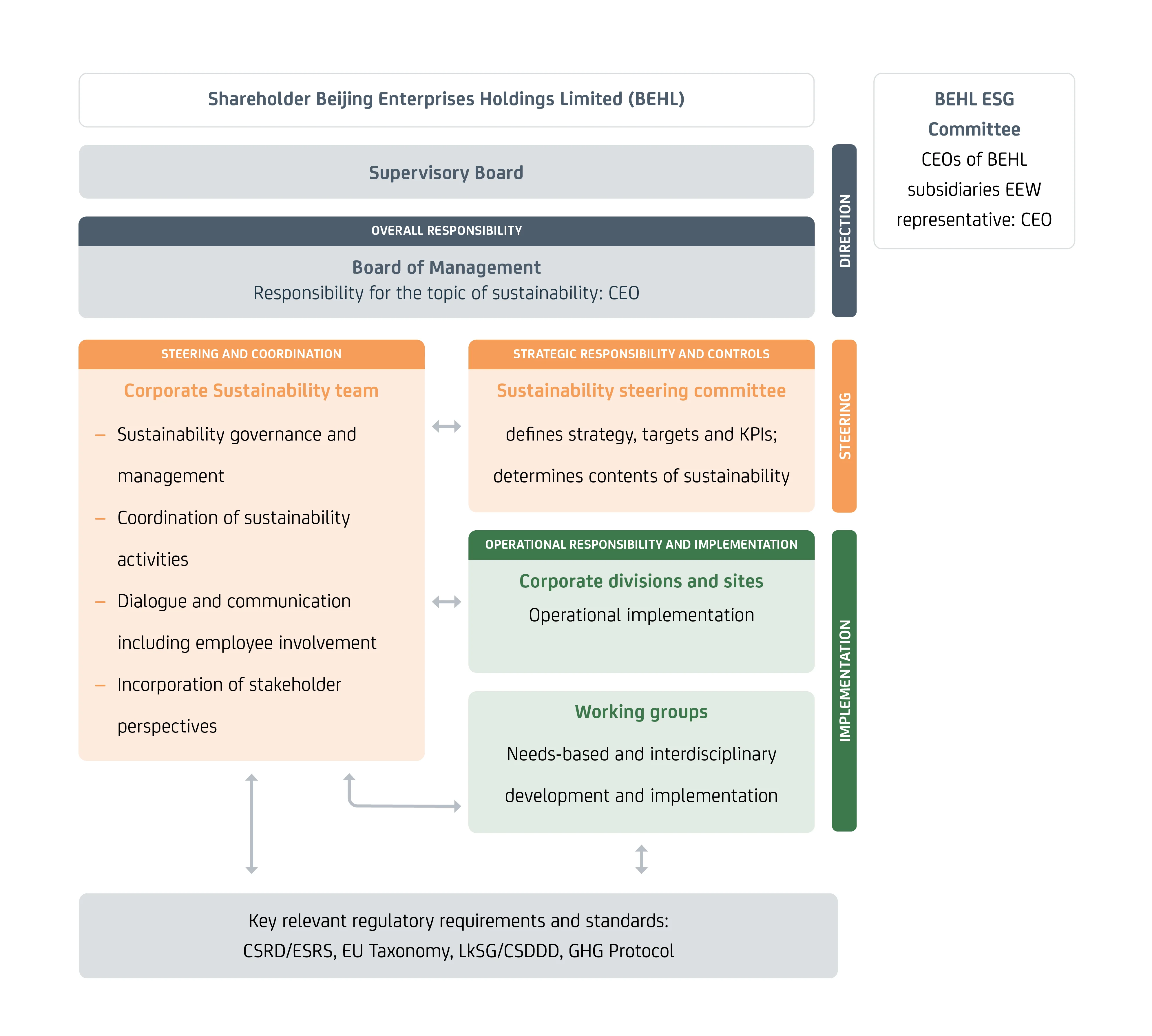
Sustainability is firmly embedded within EEW’s organisation and is managed at various levels.
Overall responsibility lies with the management board. It sets the strategic framework and takes key decisions.
A cross-functional steering group coordinates the further development of sustainability issues and ensures the link with the operational departments.
The Sustainability Team is responsible for developing the substance of our sustainability work, supporting its implementation and ensuring the further development of strategy, reporting and internal processes.
In this way, we ensure that sustainability is integrated into decision-making and effectively implemented throughout the company. We regularly review the relevance of our sustainability topics, the effectiveness of our measures and our progress towards our goals. This enables our strategy to respond to changing circumstances and remain viable over the long term.
Operational resilience and Managing Security Risks: As an operator of critical waste management infrastructure, EEW bears a special responsibility for the safe and reliable operation of its facilities. The goal is to maintain facility operations even under challenging conditions and to identify risks early on and manage them effectively.
The operation of our facilities involves specific operational risks, particularly in connection with technical processes, emissions, and potential disruptions. These include, among other things, emissions resulting from operational deviations, fire or explosion incidents, the failure of critical plant components, and the handling of hazardous substances and residual materials.
Our approach to operational resilience and risk management includes:
- Systematic requirements for operational safety, maintenance, and plant availability as part of our integrated management system
- Regular risk analyses at the plant and corporate levels
- Consideration of physical and transitory climate risks across short-, medium-, and long-term time horizons
- Continuous emissions monitoring and compliance with legal and regulatory requirements
- Regular internal and external audits to verify the effectiveness of our measures
Standardized emergency and crisis management processes are in place for exceptional events. These include site-specific emergency plans, clearly defined escalation and communication channels, as well as regular training and drills. Collaboration with the relevant authorities and emergency response teams is a central component of this process.
Relevant information on emissions and environmental impacts is collected, assessed, and documented in accordance with legal and regulatory requirements. To this end, the sites regularly prepare supporting documentation and reports for the relevant authorities. In addition, selected emissions data is made publicly available on a site-specific basis.
The effectiveness of these measures is regularly reviewed and continuously improved. The goal is to identify and prioritize risks early on and and to improve the level of safety over the long term.
Relationship to the Sustainable Development Goals
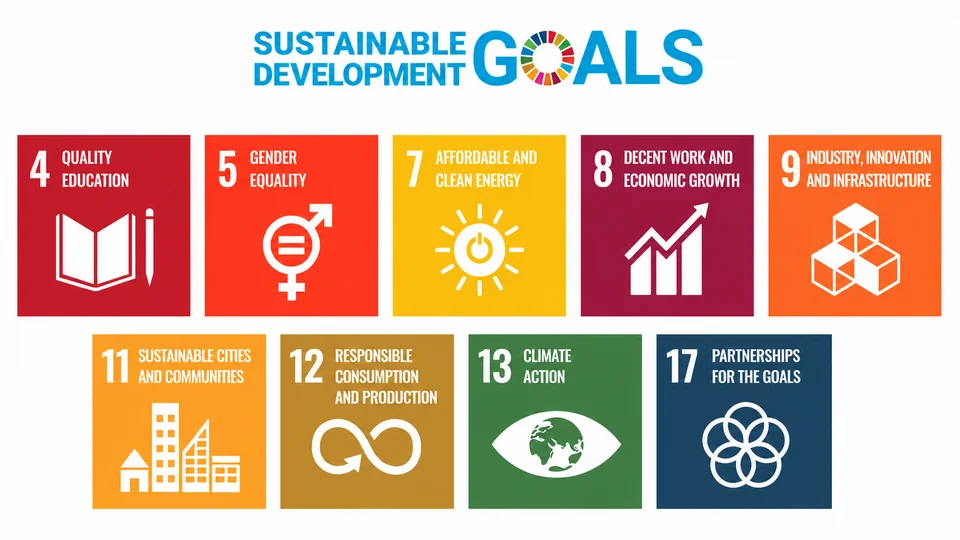
The United Nations Sustainable Development Goals (SDGs) provide an international reference framework for sustainable development. Several of the sustainability topics that are material to EEW relate to these goals.
These include, in particular, topics relating to climate and energy, resource use, working conditions and skills development, as well as responsible corporate governance and cooperation.
The SDGs shown indicate which global sustainability goals our material topics relate to. They do not constitute an assessment of the overall impact of our business activities.
Contact
Sustainability thrives on dialogue. If you have any questions or suggestions, please do not hesitate to contact us at nachhaltigkeit(at)eew-energyfromwaste.com or use our contact form.